
OEM Kitchen Appliance Manufacturing Process Step by Step
For retailers, distributors, and private-label brands sourcing kitchen appliances, understanding how an OEM partner actually builds a product is the difference between a smooth program and a costly one. The OEM kitchen appliance manufacturing process step by step follows a defined sequence: design and engineering, tooling and mold development, component sourcing, assembly, and quality control. Each stage carries its own decisions, lead times, and risks. This guide walks through that sequence from a B2B sourcing perspective, using Golenda Appliances’ real production capabilities and product range as a working example.
Step 1: Product Design and Engineering
Every OEM project begins with a specification, not a factory line. The buyer defines the target market, form factor, power class, control interface, and price positioning; the manufacturer’s engineering team translates that into a manufacturable design. Industry process breakdowns consistently place product design and engineering first, followed by tooling and mold development, component sourcing, assembly line production, and quality control ([DLJM Appliances](https://dljmappliances.com/kitchen-appliances-manufacturer-india)).
This is also where category expertise matters most. A buyer sourcing an induction platform needs a partner who already understands the electrical architecture, glass panel requirements, and control electronics involved. Golenda’s parent operation, CHK, has spent years dedicated to the research and development of smart control technologies for home appliances — the electronics layer that sits at the heart of modern cooktops. That background shortens the design cycle because core control platforms already exist and can be adapted rather than built from zero.
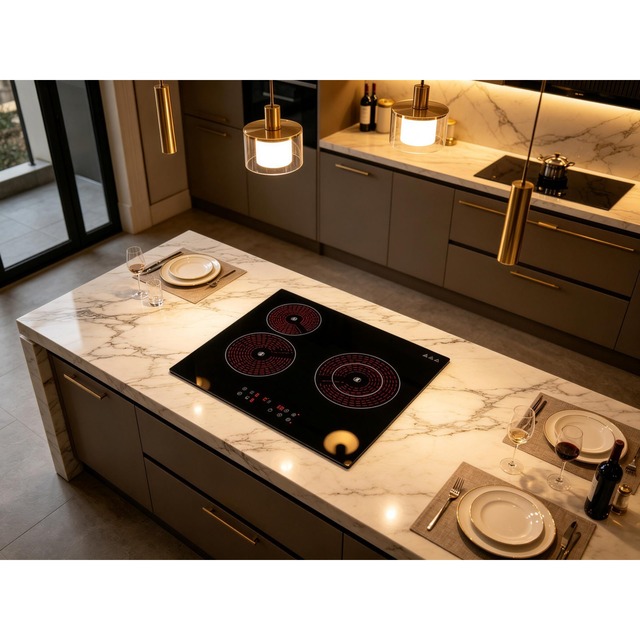
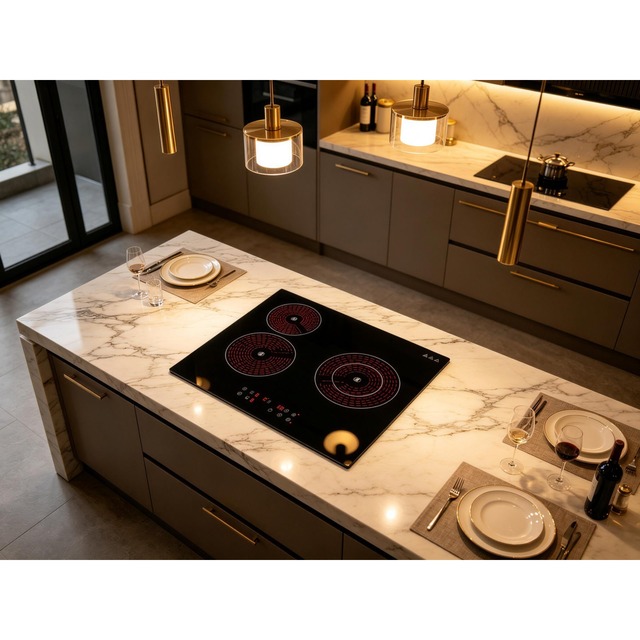
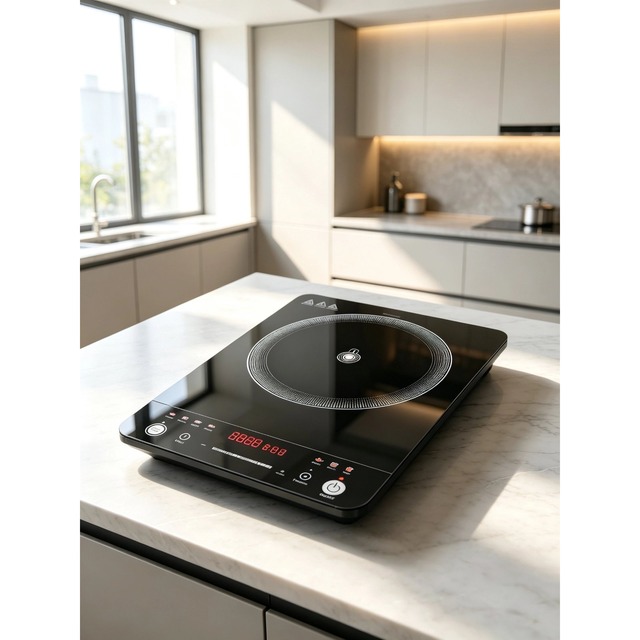
For example, a buyer targeting the European built-in market might start from a platform like the Golenda CHK-7041, a 7000W built-in induction hob with four zones, touch control, and a 99-minute timer. A buyer targeting portable retail channels might instead begin with the Golenda J22U8, a 2000W portable induction cooktop with touch key and slider controls, seven preset cooking modes, and a four-digit segment display. In both cases, the engineering step adapts an existing, proven platform to the buyer’s branding, packaging, and market requirements.
Step 2: Tooling, Component Sourcing, and Assembly
Once the design is frozen, tooling and mold development begins. This stage determines the physical form of housings, panels, and internal structures, and it is typically the longest single lead-time item in a new OEM program. Because tooling is capital-intensive, buyers should expect this step to be quoted separately and amortized across production volume.
Component sourcing follows. A kitchen appliance is an assembly of many purchased parts — heating elements, control boards, glass panels, wiring, and hardware — and sourcing decisions directly affect cost, consistency, and compliance. The manufacturing process overall is a multi-step operation involving unit operations, material handling, and quality checks, with defined mass balance, raw material requirements, and technical testing criteria ([IMARC Group](https://www.imarcgroup.com/kitchen-appliances-manufacturing-plant-project-report)).
Assembly then takes place on the production line. Golenda’s new production base, launched in November 2025, operates under a comprehensive 4S management system designed to ensure streamlined operations, strict quality control, and consistent output from raw components through to finished goods. For buyers, this matters because consistency across repeat orders is one of the hardest things to guarantee in appliance manufacturing — and one of the most expensive to get wrong.
The breadth of Golenda’s platform range supports different sourcing strategies from the same factory. A buyer building a full cooktop lineup could combine the GXMC-AF01, a 7200W built-in infrared cooktop with four burners and dual symbol touch button control, with the EC360-5202, a 5200W built-in infrared cooktop featuring three zones including a 230mm dual-power rear zone. A buyer focused on entry-level or portable channels could add the 1000W single burner portable infrared cooker with ten power levels and an A-grade integral micro-crystal panel. Beyond cooktops, Golenda also manufactures air fryers, built-in ovens, range hoods, gas hobs, and dishwashers — useful for buyers who want to consolidate several categories under one OEM relationship rather than managing multiple suppliers.
Step 3: Quality Control and Compliance
Quality control is not a final inspection — it runs across the entire process. Incoming components are checked before they reach the line, in-process checks catch assembly defects early, and finished units undergo functional and safety testing before packing. Technical testing criteria and quality assurance checkpoints are standard elements of any credible appliance manufacturing flow ([IMARC Group](https://www.imarcgroup.com/kitchen-appliances-manufacturing-plant-project-report)).
Compliance is a parallel workstream. For European buyers, energy labeling and related requirements must be addressed during design, not after production. Golenda publishes B2B guidance on EU energy label requirements for kitchen appliances, and several of its cooktop models — including the EC360-5202 and CHK-7041 — carry CE and CB certification. Buyers should confirm the exact certification scope required for their target market during the specification stage, since retrofitting compliance is far more expensive than designing for it.
Market context reinforces why this category is worth the effort. The household induction cooktops market was valued at USD 5.30 billion in 2026 and is projected to reach USD 10.78 billion by 2035, growing at a CAGR of 8.20%, according to Precedence Research ([Precedence Research](https://www.precedenceresearch.com/household-induction-cooktops-market)). Europe dominated the global household induction cooktops market in 2026 with a 38.6% share, driven by consumer preference for energy-efficient appliances, high electricity costs, and strict environmental regulations ([Coherent Market Insights](https://www.coherentmarketinsights.com/market-insight/household-induction-cooktops-market-4572)). For OEM buyers, that combination of growth and regulation makes partner selection a strategic decision rather than a transactional one.
Recent Company News
Golenda’s manufacturing footprint has expanded significantly. In November 2025, the company launched a new production base operating under a comprehensive 4S management system, with full automation and strict quality control from raw components to finished products.
On the corporate side, CHK (Stock Code: 831167) successfully listed on the Beijing Stock Exchange on May 27, holding a listing ceremony at its headquarters in Guangming. CHK has long focused on research and development of smart control technologies for home appliances.
Golenda has also announced the establishment of a multi-million-dollar annual innovation fund, described as an unprecedented commitment to sustained creativity and core competitiveness. For OEM buyers, these developments signal manufacturing capacity, capital-market discipline, and continued investment in the control technology that underpins its cooktop platforms.
Conclusion
The OEM kitchen appliance manufacturing process step by step is straightforward to describe and demanding to execute: engineer the product, build the tooling, source components, assemble on the line, and control quality throughout. What separates suppliers is depth at each stage — proven control platforms, disciplined production management, and compliance readiness for regulated markets. Buyers evaluating OEM partners should ask specifically about design reuse, tooling ownership, in-process quality checkpoints, and certification scope before committing to a program.
About Golenda Appliances
Golenda Appliances is a Chinese OEM/ODM kitchen appliance manufacturer producing induction cooktops, infrared cookers, gas hobs, built-in ovens, range hoods, dishwashers, and air fryers. Its product range includes the CHK-7041 7000W four-zone built-in induction hob, the EC360-5202 5200W three-zone built-in infrared cooktop, the GXMC-AF01 7200W four-burner built-in infrared cooktop, the J22U8 2000W portable induction cooktop, the 1000W portable infrared cooker, and the KS-A01S digital air fryer. The company operates a new production base under 4S management and is backed by CHK, listed on the Beijing Stock Exchange.
Sources
- https://dljmappliances.com/kitchen-appliances-manufacturer-india
- https://www.imarcgroup.com/kitchen-appliances-manufacturing-plant-project-report
- https://www.precedenceresearch.com/household-induction-cooktops-market
- https://www.coherentmarketinsights.com/market-insight/household-induction-cooktops-market-4572