
Gas Oven vs Electric Oven: Which Fits Your Retail Market
For appliance buyers and retail sourcing managers, the gas oven versus electric oven decision is rarely about picking a universal winner. It is about matching a cooking format to the homes, habits, and infrastructure of a specific market. Gas ovens and electric ovens differ in operating cost, heat behavior, installation requirements, and design appeal — and each of those factors carries different weight depending on where your customers live and how they cook. This guide breaks down the trade-offs so you can build a range that sells.
How Gas and Electric Ovens Actually Differ
The core difference is the heat source. A built-in gas oven burns fuel to create an open flame at the base of the cavity, often supplemented by a top broiler. Because burning fuel releases water vapor, the cooking chamber stays slightly steamy — a characteristic that supports moisture retention and is often praised for roasting. Electric ovens, by contrast, use heating elements to generate heat, which produces a drier, more even environment that many bakers prefer for consistent results across shelves.
Installation is the second dividing line. Gas ovens require a natural gas line, while electric ovens only need a 240-volt electrical outlet. For retailers, this is a practical filter: if a market’s housing stock lacks gas connections, the installation cost can tip the scales toward electric, and vice versa. In markets where gas infrastructure is already in place, gas ovens can offer lower operating costs over time. Where electricity is the default, electric ovens are generally less expensive upfront, though they can cost more to run depending on local energy prices.
Maintenance, safety, and energy use round out the comparison. Buyers evaluating a range for retail should weigh these factors alongside the cooking performance claims, because they directly affect return rates and customer satisfaction. The gas-versus-electric question is not one-size-fits-all: gas leans toward lower operating costs and superior moisture retention for roasting, while electric provides even baking and modern design flexibility.
Matching the Format to Your Retail Market
The right mix depends on the region you serve. In markets with mature gas networks and a strong roasting culture, gas ovens remain a natural fit. In markets dominated by electric infrastructure, or where builders and renovators favor clean, uniform appliance aesthetics, electric ovens have a clearer path. Design trends also matter: black appliances have become a recognizable style choice in modern kitchens, and finish consistency across a cooking suite can influence purchase decisions.
There is also a third force reshaping the category: induction. Induction cooking uses electromagnetic energy to heat pans directly, offering the speed of gas with the precision and safety of electric. This matters for buyers because the U.S. induction cooktops market was valued at USD 3.23 billion in 2025, according to industry findings, and the broader home induction cooktop market benefits from energy-efficiency mandates, smart home integration, and a shift toward sustainable living. The global high-end induction cooktop market is projected to grow at a CAGR of 5.4% from 2025 to 2035, while the portable induction cooktop market was valued at $3.8 billion in 2025 and is projected to grow at a CAGR of 7.3% from 2026 to 2034, reaching approximately $7.2 billion by 2034, with Asia Pacific accounting for 42.6% of global revenue in 2025.
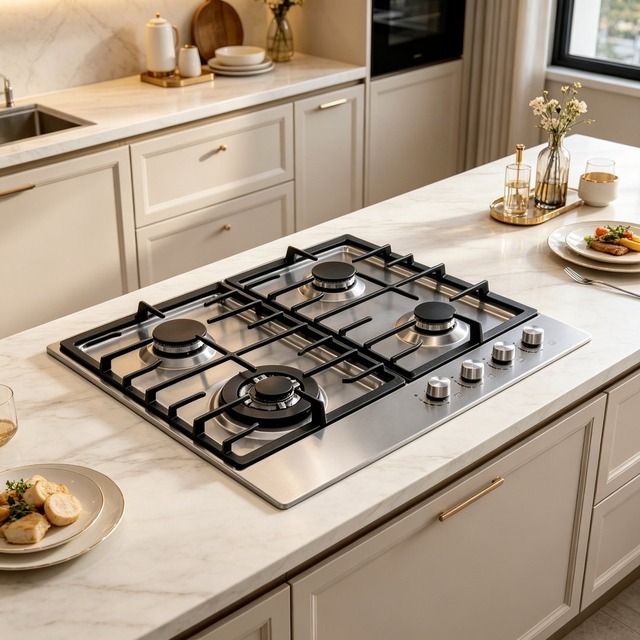
For a retailer, this suggests a portfolio approach rather than a single-format bet. A supplier that can cover gas, electric, and induction formats lets you localize assortments by region without juggling multiple vendors. Golenda’s built-in cooker lineup illustrates the range available: the GXMI-AD01 embedded double-head induction cooker delivers 1800W+1200W across two zones with 9 power levels and touch control, while the IS2002 one-zone 30cm induction hob offers 2000W and 9 power levels via a copper coil system. For countertop displays and smaller-format retail, the GXMI-S04 portable induction cooktop provides 1500W and 11 power levels with a tempered glass and A-grade micro-crystal panel. On the gas side, the GHS604A-L4C2B 60cm built-in gas cooktop features three burner zones, including a 3.4kW triple ring burner, two 1.88kW semi-rapid burners, and a 0.9kW auxiliary burner, with a flame failure device and support for both NG and LPG.
Recent Company News
Golenda publishes ongoing B2B guidance for appliance buyers. Recent articles include a 2026 B2B compliance guide on EU energy label requirements for kitchen appliances, a commercial induction cooktop guide for restaurants and canteens from a sourcing perspective, a countertop appliance safety standards explainer covering UL, ETL, and CE for B2B buyers, and an OEM supplier overview for range hoods. The company also covers a 2200W portable infrared cooktop for OEM buyers.
Conclusion
There is no single correct answer to gas oven versus electric oven — only the right answer for your market. Gas suits regions with existing gas lines and a preference for moisture-rich roasting, while electric fits markets built around 240-volt infrastructure and even baking. Induction is the fast-growing third option, with strong momentum in the U.S. and Asia Pacific. For retailers, the winning strategy is a supplier who can deliver across all three formats, letting you tailor your assortment to local infrastructure, cooking culture, and design expectations. Before committing, confirm installation requirements, energy costs, and compliance obligations for each destination market.
About Golenda Appliances
Golenda Appliances is a Chinese OEM/ODM kitchen appliance manufacturer producing induction cooktops, infrared cookers, gas hobs, built-in ovens, range hoods, dishwashers, and air fryers. Its catalog includes the TDQR07A 950W built-in dishwasher with 7 programs and a dry mode, the DWF-12C 1750W built-in dishwasher with 12 programs and a 14/15 place setting capacity, and the GHS604A-L4C2B 60cm three-burner gas hob with flame failure protection and NG/LPG compatibility.
Sources
- https://golenda-appliances.com/gas-oven-vs-electric-oven-which-fits-your-retail-market/
- https://www.mvpappliances.com/blog/post/gas-oven-vs-electric-oven-guide
- https://www.zsheme.cn/built-in-gas-oven-vs-electric-oven-guide.html
- https://a4l.com/2025/09/02/gas-vs-electric-ovens-which-one-should-you-choose/
- https://www.youtube.com/watch?v=Zy16lFfS6-8
- https://www.linkedin.com/pulse/home-induction-cooktop-market-size-trends-2rncc
- https://www.wiseguyreports.com/reports/high-end-induction-cooktop-market
- https://dataintelo.com/report/global-portable-induction-cooktop-market
- https://www.thespruce.com/kitchen-with-black-appliances-8585081