
Infrared Cooker vs Induction Cooker: Key Differences Explained
For appliance buyers and distributors, the choice between infrared cookers and induction cookers is not simply a matter of preference — it shapes the product mix you offer, the customers you serve, and the technical support you provide. Both categories fall under the electric cooking umbrella, yet they work on fundamentally different principles. This guide breaks down the key differences so B2B buyers can make informed sourcing decisions.
How Each Technology Works
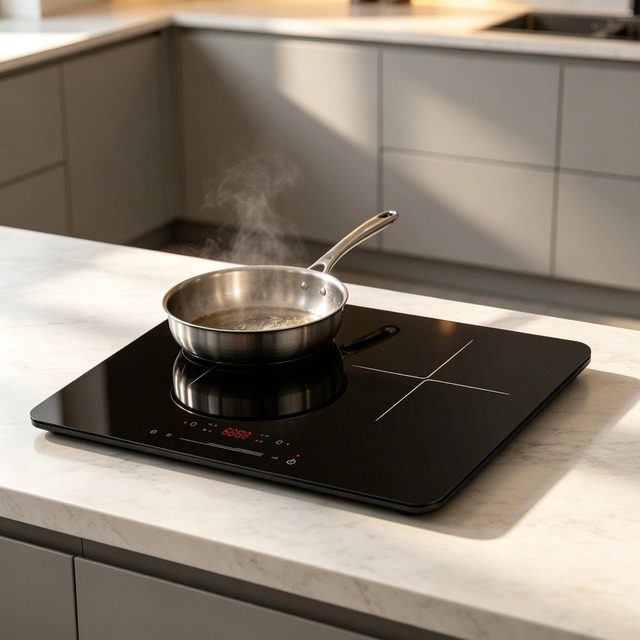
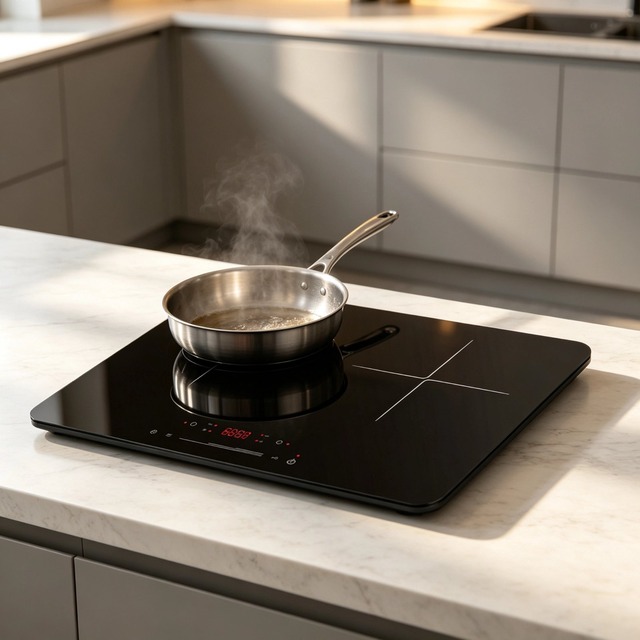
An induction cooker generates a magnetic field that induces current directly in the base of compatible cookware. The pot itself becomes the heat source, which is why induction is often associated with fast heating and precise control. Golenda’s induction lineup illustrates the range of formats available: the CHK-DS3502 portable induction cooktop delivers dual-zone cooking with a total power of 2KW+2KW (max 3.5KW) on a 605x370mm touch-control panel, while the PIT07B70CAD built-in induction hob offers 7000W across three zones, including a 280mm right zone rated at 3000W with 3500W boost. For smaller installations, the CHK-ID3002 Domino built-in induction hob provides 3000W across two 165mm zones, with a front zone at 1800W and a rear zone at 1200W. Common to these models are touch control, 9-stage power settings, and a 99-minute digital timer.
An infrared cooker, by contrast, uses a heating element that radiates infrared energy to the cookware and the surrounding air. Heat transfer does not depend on magnetic properties, so glass, ceramic, and aluminum cookware can generally be used. Golenda’s 800W portable infrared cooktop is an example of this category in a compact, portable format. Because infrared heats the surface rather than the vessel directly, the cooking experience differs from induction in both responsiveness and residual heat.
Performance, Cookware, and Use Cases
The practical differences matter most at the point of sale. Induction tends to heat faster and respond more immediately to power adjustments, and the glass surface stays relatively cooler because energy transfers to the pot rather than the panel. That efficiency story is resonating with end users: the household induction cooktops market was valued at USD 4.90 billion in 2025 and is projected to grow at a CAGR of 8.20% from 2026 to 2035, driven by demand for energy-efficient, smart, and safe cooking solutions. Europe led the global household induction cooktops market in 2026 with a 38.6% share, supported by high electricity costs, environmental regulations, and government incentives.
Infrared cookers, meanwhile, appeal to buyers who want cookware flexibility and often a lower entry price point. They can be a practical option for markets where induction-compatible pots are less common, or for portable and budget-oriented segments. The trade-off is typically slower response and more residual heat on the cooking surface.
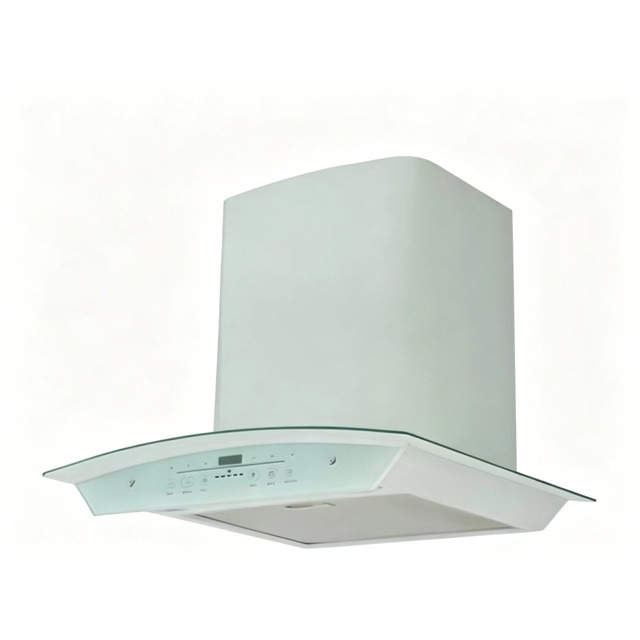
For distributors building a portfolio, the two technologies can be complementary rather than competing. A range that includes portable induction, built-in induction, and infrared options lets you address different price tiers and cooking cultures. Golenda’s broader catalog supports this approach, spanning portable cookers, built-in cookers, range hoods such as the JO-BF031 600mm chimney hood with 860 m³/hr airflow, and small appliances like the AF-50HM 5L air fryer with slide control.
What Buyers Should Evaluate Before Sourcing
When comparing suppliers, look beyond the headline wattage. Consider the control interface — touch control versus knob or slide mechanisms — and whether timers and staged power settings match your market’s expectations. Certification and compliance documentation matter for cross-border sales; for example, the CHK-ID3002 carries CE and CB certification. Also assess whether the manufacturer can support both technologies under one roof, which simplifies ordering, quality control, and after-sales coordination.
Manufacturing capability is another differentiator. Golenda Appliances launched a new production base in November 2025, operating under a 4S management system with full automation to support consistent quality from raw components to finished goods. The company has also established a multi-million-dollar annual innovation fund to drive core competitiveness, and its parent CHK listed on the Beijing Stock Exchange on May 27 under stock code 831167.
Recent Company News
Golenda Appliances unveiled its new production base in November 2025, featuring 4S management and full automation. The company also announced a multi-million-dollar annual innovation fund aimed at strengthening its core competitiveness. In a separate milestone, CHK successfully listed on the Beijing Stock Exchange on May 27, trading under stock code 831167.
Conclusion
Infrared and induction cookers serve different needs, and neither replaces the other outright. Induction offers speed, precision, and energy efficiency, with a growing global market behind it. Infrared offers cookware flexibility and accessibility. For B2B buyers, the strongest strategy is often a portfolio that covers both — sourced from a manufacturer with the production infrastructure and innovation commitment to support it. Golenda Appliances manufactures induction cooktops, infrared cookers, gas hobs, built-in ovens, range hoods, dishwashers, and air fryers for OEM and ODM programs, and can help buyers match the right technology to the right market.
About Golenda Appliances
Golenda Appliances is a Chinese OEM/ODM kitchen appliance manufacturer producing induction cooktops, infrared cookers, gas hobs, built-in ovens, range hoods, dishwashers, and air fryers. The company operates a new production base launched in November 2025 with 4S management and full automation, and has established a multi-million-dollar annual innovation fund. Its parent company, CHK, listed on the Beijing Stock Exchange on May 27 under stock code 831167.
Sources
- https://finance.yahoo.com/news/global-electric-rice-cooker-market-153000081.html
- https://finance.yahoo.com/news/electric-rice-cooker-market-global-114600131.html
- https://finance.yahoo.com/news/cuckoo-debuts-fall-2025-rice-183000526.html
- https://www.prnewswire.com/news-releases/kitchenaid-redefines-the-kitchen-with-industry-leading-innovation-at-kbis-2026-302683689.html
- https://vegnews.com/new-kitchen-appliances-of-2026
- https://www.dewaardandbode.com/blog/kitchen-appliance-design-trends
- https://www.harveyjones.com/blog/planning/best-kitchen-appliances-2026
- https://www.thekitchn.com/kbis-best-in-show-2026-23771358
- https://www.snsinsider.com/reports/induction-cooktops-market-9823
- https://www.precedenceresearch.com/household-induction-cooktops-market
- https://www.coherentmarketinsights.com/market-insight/household-induction-cooktops-market-4572
- https://www.cognitivemarketresearch.com/induction-cooktop-market-report
- https://www.ajmadison.com/learn/cooking/trends/cooking-appliance-trends-2026